
Rep. Al Green … Black People Aren't Apes, Mr. President!!!
Rep. Al Green at State of the Union
Rep. Al Green Ejected from State of the Union After Sign Protest, Reigniting Debate Over Race, Rhetoric, and Decorum
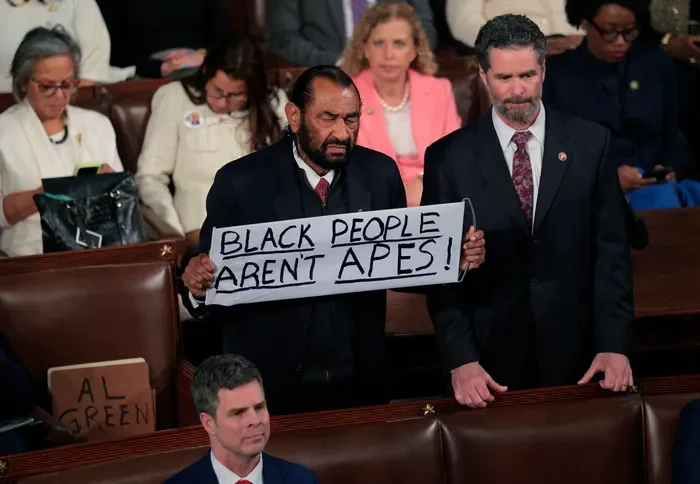
Rep. Al Green (D‑TX) was escorted out of the House chamber during President Donald Trump’s 2026 State of the Union after raising a hand‑lettered placard that read, “Black People Aren’t Apes,” a pointed reference to a video Trump previously shared depicting Barack and Michelle Obama as apes. The image—posted to Trump’s Truth Social account earlier in February and later deleted—had drawn swift criticism across the political spectrum, and Green’s protest placed that controversy squarely in the camera frame at the year’s most watched political ritual. [tmz.com], [nbcnews.com] [tmz.com], [time.com]
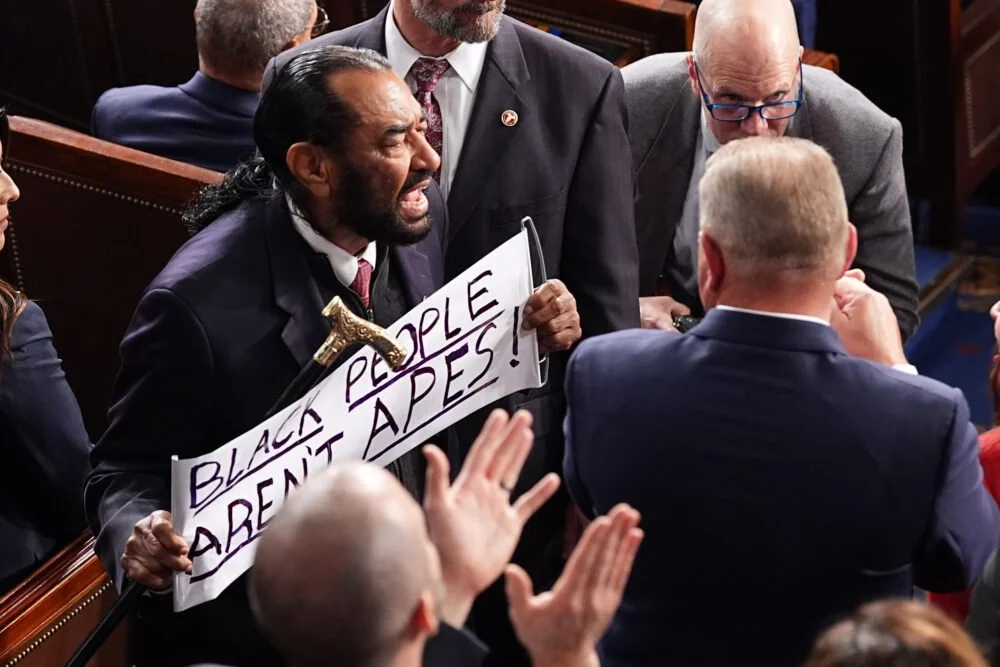
Capitol security moved to remove Green within minutes of the president’s arrival, as lawmakers on the Republican side attempted to seize the sign amid a brief scuffle in the aisle captured by press pool cameras. The Texas Democrat, 78, has a history of direct confrontation at high‑profile addresses; he was ejected from last year’s joint address after a spontaneous outburst, and aides said this year’s protest was a deliberate effort to ensure the president “got the message.” [tmz.com], [nbcwashington.com] [nbcnews.com], [thegrio.com]
Journalists in the chamber reported that Green had positioned himself on the aisle to maximize visibility as Trump entered, lifting the sign as the president walked past and continuing to hold it aloft as Republicans jeered. NBC News and local affiliates noted an attempt by at least one GOP member to snatch the placard before sergeants‑at‑arms escorted Green out, a sequence that underscored the evening’s raw tensions. Green later told reporters that the act was intentional and that “Trump got the message,” emphasizing what he framed as a necessary stand in response to racist content amplified from the president’s account. [nbcnews.com], [time.com] [nbcnews.com], [nbcwashington.com] [nbcnews.com], [thegrio.com]
Rep. Al Green at State of the Union
Rep Al Green makes it clear where he stand
The flashpoint did not occur in a vacuum. Earlier this month, the president’s Truth Social feed featured a clip portraying the Obamas as primates, before the post was removed amid bipartisan criticism and national coverage that revived long‑standing debates over race in American politics. While the White House and allies offered shifting explanations over responsibility for the post, outside observers noted that the episode fit a familiar pattern in which offensive material circulates, dominates a news cycle, and is then disavowed without a full apology. Former President Obama called the spectacle a “clown show” in a media appearance, a remark widely quoted in follow‑up reporting and referenced explicitly in entertainment and political outlets alike. [tmz.com], [time.com] [thegrio.com], [time.com] [tmz.com], [nbcwashington.com]
Green’s protest also intersected with a broader strategic divide over how Democrats should respond inside the chamber. Many members adopted a posture of restrained dissent for much of the evening, but outbreaks of vocal protest—most prominently from progressive lawmakers—periodically punctured the president’s remarks and highlighted the difficulty of maintaining a single tactical line in a polarized environment. TIME’s account described the night as oscillating between tense silence and sudden flashpoints, with Green’s sign serving as the earliest and most visually memorable rupture. [time.com]
Politically, the episode may have ramifications at home and in the Capitol. Green faces a competitive primary in a newly drawn Houston‑area district, and his allies argue that visible moral clarity on questions of race remains a galvanizing force for his base. In Washington, Republicans seized on the incident as evidence of Democratic incivility, while Democrats countered that the objection targeted racist content, not the office of the presidency—a debate that is likely to spill into committee rooms, cable segments, and fundraising emails. [nbcnews.com], [nbcwashington.com] [nbcnews.com], [time.com]
From a historical perspective, congressional protest during nationally televised addresses is not new, but such acts have grown more frequent and sharply symbolic in the social media era, where a single image can dominate discourse beyond the confines of the speech itself. Green’s sign distilled an argument about dignity and representation into five words legible to cameras and phones alike, ensuring that even viewers tuning in late understood the fault lines that framed the night. [time.com], [usatoday.com] [tmz.com], [usatoday.com]
By evening’s end, the White House sought to move the focus back to the president’s policy themes, but coverage across national and local outlets led with the confrontation, signaling how symbolic acts can eclipse even a meticulously scripted address. Whether the moment shifts public opinion is uncertain; what’s clear is that the State of the Union remains not just a report on policy, but a stage for defining images—and that in 2026 one of those images was a sign stating the obvious in order to contest the unacceptable. [time.com], [nbcwashington.com] [nbcnews.com], [tmz.com]
Sources: TMZ, NBC News, TIME, USA Today, NBC Washington, TheGrio.
